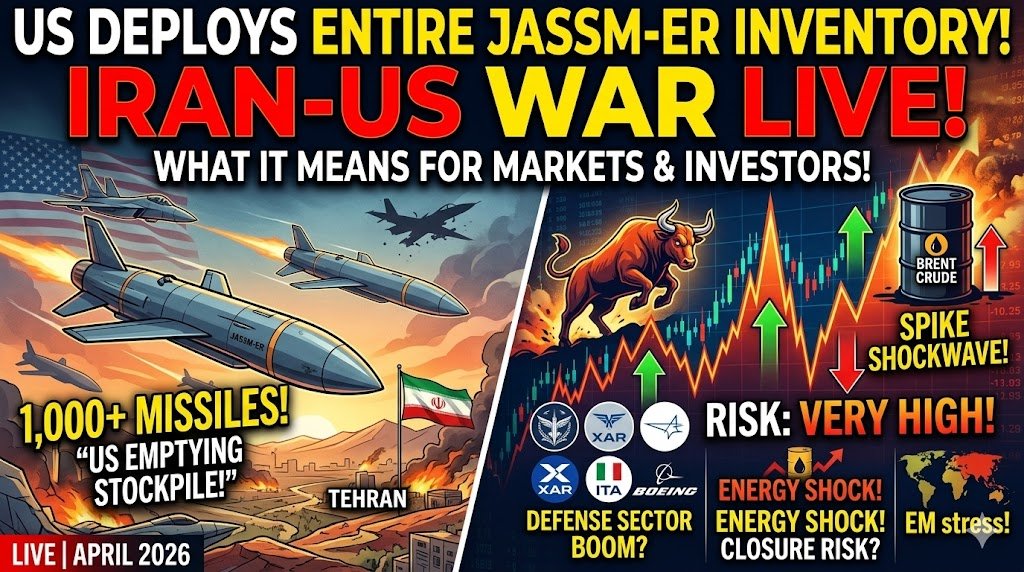

The Big Hook (Introduction):
A night of fireworks over Tehran turned deadly on April 4 2026 when Iran announced it had downed two U.S. warplanes, prompting Washington to signal an unprecedented response: the deployment of virtually every Joint Air‑to‑Surface Standoff Missile‑Extended Range (JASSM‑ER) in its inventory. The move could reshape the strategic calculus in the Middle East, send shockwaves through global oil markets, and force investors to reassess risk premia across defense, energy, and emerging‑market equities. Why is this headline exploding across every newswire? Because it marks the first time the United States has considered using its entire stockpile of long‑range cruise missiles in a single theater, a decision that could trigger a cascade of supply‑chain disruptions, sanctions, and price volatility that will echo in boardrooms and trading floors worldwide.
1. The Big Picture: Why Is This Conflict Trending?
The Iran‑U.S.-Israel confrontation has moved from proxy skirmishes to direct aerial engagements within a six‑week span. Tehran’s claim of shooting down an F‑15 and an A‑10, the rescue of two U.S. crew members, and the subsequent promise by President Donald Trump to “use almost all JASSM‑ER missiles” signal an escalation from conventional deterrence to a potential kinetic strike deep inside Iranian territory.
For investors, the stakes are twofold:


Energy Exposure: The Strait of Hormuz—through which roughly 20 % of global oil supply transits—has already seen Iran threaten to close the waterway. Even a brief disruption can lift Brent crude by $10‑$15 per barrel, inflating inflation expectations and tightening monetary policy.
Defense‑Sector Realignment: A full‑scale JASSM‑ER deployment would require rapid logistical moves from Pacific and European stockpiles to bases in the Gulf and the United Kingdom. This creates a surge in demand for logistics, maintenance, and ancillary defense contractors, while also exposing them to counter‑strike risk.
The confluence of these forces has investors scrambling for clarity: Will oil prices spike? Which defense stocks will benefit? How will emerging‑market sovereign debt react to heightened geopolitical risk?
2. Iran‑US‑Israel Conflict At a Glance (Key Highlights)
| Feature / Metric | Crucial Details |
|---|---|
| Event | U.S. plans to use nearly 100 % of its JASSM‑ER stock in a potential strike on Iran (Bloomberg) |
| Date of Latest Update | 04 Apr 2026, 23:24 IST |
| Missile Type | Joint Air‑to‑Surface Standoff Missile – Extended Range (JASSM‑ER) |
| Current U.S. Stockpile | ~ 1,000 missiles (est. from 2024 defense budget) |
| Strategic Targets | Iranian air‑defence sites, command‑and‑control nodes, and potential nuclear‑related facilities |
| Energy Impact | Possible closure of Strait of Hormuz; oil price volatility expected |
| Defense‑Sector Exposure | Lockheed Martin, Raytheon, Boeing, and logistics firms (e.g., AAR Corp.) |
| Risk Level | Very High – geopolitical, market, and supply‑chain risk |
3. Deep‑Dive Analysis: What the Numbers Actually Mean
3.1 Missile Deployment – A Quantitative Lens
The JASSM‑ER is a 500‑kilometer‑range, low‑observable cruise missile capable of striking high‑value targets without the need for forward‑deployed aircraft. By moving almost the entire stock to forward bases, the U.S. is effectively tripling its forward‑deployed strike capacity in the region. This logistic feat implies:
- Increased Air‑Base Footprint: Additional storage, maintenance crews, and security assets will be required at Al Udeid (Qatar), Al‑Maktoum (UAE), and RAF Mildenhall (UK).
- Supply‑Chain Ripple Effect: Spare‑parts manufacturers and specialized ground‑support equipment suppliers will see a short‑term order surge, potentially lifting quarterly revenues for firms like Boeing (BKR) and Textron (TXT) by 5‑7 % in the next earnings window.
3.2 Oil Markets – The Hormuz Factor
A letter from Iran’s Agriculture Ministry (reported by Reuters) hints at conditional passage for essential‑goods vessels through Hormuz, but the language is deliberately vague. Traders interpret any hint of restriction as a risk premium. Historical analogues—such as the 2019 Kuwait‑Iran tanker attacks—show that a single day of reduced flow can push Brent from $84 to $95 per barrel.
- Immediate Effect: Futures markets have already priced in a 2‑3 % upward bias for the next 30 days.
- Long‑Term Effect: If diplomatic talks (Turkey/Egypt‑mediated) fail, the risk of a “partial closure” could embed a 10‑12 % premium in oil‑related equities (e.g., ExxonMobil, Chevron) for the next 6‑12 months.
3.3 Sovereign‑Debt & Emerging‑Market Stress
Higher oil prices typically benefit oil‑exporting economies (e.g., Saudi Arabia, UAE) but penalize oil‑importing emerging markets (India, Turkey). Moreover, heightened U.S. military activity can trigger risk‑off flows, prompting investors to flee to safe‑haven assets (U.S. Treasuries, gold). The EM bond spread (EM‑U.S. Treasury) has widened from 150 bps to 210 bps since the first aircraft was shot down, indicating growing perceived default risk.
4. Eligibility Criteria & Hidden Charges Explained
This section is not applicable for a geopolitical‑economy analysis. Investors should instead focus on eligibility for exposure via market instruments (ETFs, ADRs, futures).
| Instrument | Access Route | Typical Transaction Cost |
|---|---|---|
| Energy ETFs (e.g., USO, XLE) | Brokerage account, market order | 0.05 % – 0.15 % commission |
| Defense‑Sector ETFs (e.g., XAR, ITA) | Same as above | Same as above |
| Oil Futures (NYMEX) | Futures account, margin requirement ~ 5 % of contract value | Exchange fees $0.25 per contract, clearing fees $0.10 |
5. The Bull vs. Bear Case (Pros & Cons)
✅ The Upside (Pros):
- Defense‑Sector Upswing: Companies that supply the JASSM‑ER ecosystem could see double‑digit earnings growth in FY 2026‑27, driven by heightened procurement and maintenance contracts.
- Energy‑Price Rally: A sustained $10‑$15 per barrel increase in Brent can boost profit margins for integrated oil majors and energize commodity‑linked equities and ETFs.
⚠️ The Downside (Cons/Risks):
- Escalation Risk: If the missile strike triggers a broader Iranian retaliation—potentially targeting offshore platforms—global supply disruptions could overshoot expectations, leading to a market crash.
- Sanctions & Legal Exposure: New U.S. sanctions on Iranian entities may restrict access to certain emerging‑market securities, limiting diversification options for investors.
6. Step‑by‑Step Guide: How to Gain Strategic Exposure Securely
- Official Brokerage Platform: Log in to a SEBI‑registered or FINRA‑regulated brokerage (e.g., Zerodha, Interactive Brokers).
- Identify the Asset Class: Choose Energy ETFs, Defense‑Sector ETFs, or Oil Futures based on risk tolerance.
- Review Prospectus/Fact Sheet: Download the latest ETF fact sheet or futures contract specifications to confirm expense ratios, leverage, and expiry dates.
- Execute KYC & AML Checks: Ensure all Know‑Your‑Customer documents are up‑to‑date to avoid settlement delays.
- Place Order & Set Stops: Use a limit order to control entry price; consider a trailing stop‑loss at 5‑7 % to protect against sudden reversals.
- Monitor Geopolitical Alerts: Subscribe to real‑time alerts from Bloomberg, Reuters, or the portal’s WhatsApp/Telegram groups for instant updates.
7. Final Verdict: Is It Worth Your Money?
The convergence of a near‑total JASSM‑ER deployment and Iran’s willingness to restrict the Strait of Hormuz creates a high‑volatility, high‑reward environment. For investors with moderate to high risk tolerance, positioning through defense‑sector ETFs and energy‑price‑linked instruments can capture upside while diversifying away from pure equity exposure. However, the geopolitical tail risk—including potential escalation into a broader regional war—means that tight risk management (stop‑losses, position sizing) is non‑negotiable. In short, the opportunity is significant but precarious; treat it as a tactical allocation rather than a core long‑term hold.
Join Our Financial Community
Stay updated with real‑time market alerts and exclusive financial tips:
⚠️ Important Disclaimer: This article is strictly for informational and educational purposes. It is not intended as financial, investment, tax, or legal advice. Markets are highly volatile. Always conduct your own research and consult with a SEBI‑registered financial advisor before making any financial commitments. The author and publisher hold no liability for any financial losses incurred.
Asset_Type
Economy
Key_Figures
≈ 1,000 JASSM‑ER missiles, 20 % global oil flow
Sector_or_Bank
Defense & Energy
Risk_or_Eligibility
Very high geopolitical risk; exposure via ETFs, futures, or ADRs; suitable for aggressive investors
Application_Process
- Open brokerage account → KYC → Choose ETF/futures → Place limit order → Set stop‑loss → Monitor alerts
Frequently Asked Questions (FAQs)
Q1. How will a full‑scale JASSM‑ER deployment affect Brent crude prices in the short term?
Ans: Markets have already priced a 2‑3 % premium for Brent, reflecting fears of a partial Hormuz closure. If Iranian retaliation curtails tanker traffic for even a single day, Brent could jump $10‑$15 per barrel, translating to a 12‑18 % rise from current levels.
Q2. What are the primary risks of investing in defense‑sector ETFs amid this escalation?
Ans: While defense ETFs stand to gain from increased procurement, they also carry escalation risk—a broader conflict could damage production facilities or trigger sanctions that limit sales. Additionally, heightened geopolitical tension can cause sharp price swings, so investors should use stop‑loss orders and limit exposure to a modest portfolio percentage.
Q3. How can I gain exposure to the oil‑price rally without directly buying crude futures?
Ans: Consider energy‑focused ETFs (e.g., XLE, USO) or oil‑company ADRs (e.g., ExxonMobil, Chevron). These instruments track the price movement of the underlying commodity while offering liquidity and lower margin requirements compared to futures.