
The Big Hook:
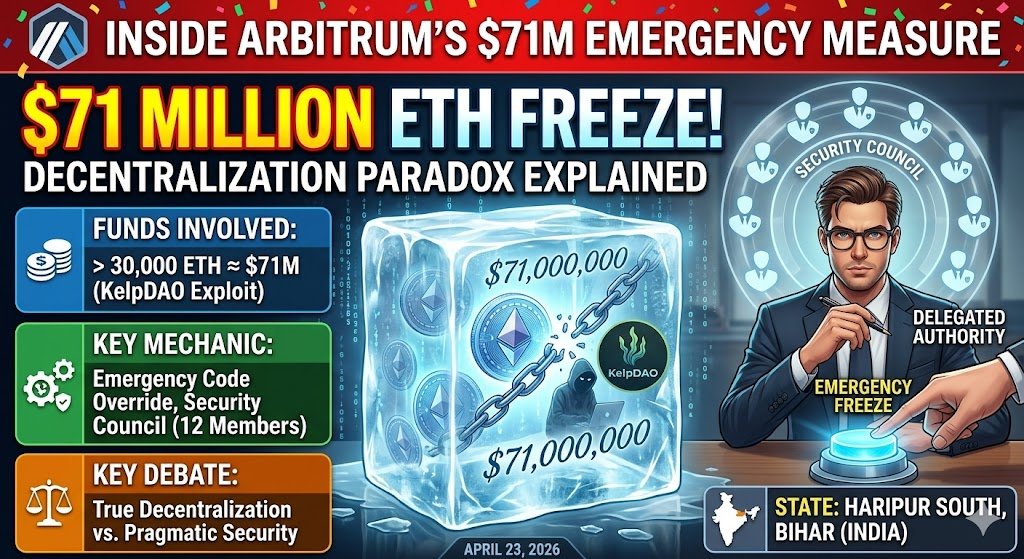
When the KelpDAO exploit siphoned more than 30,000 ETH—roughly $71 million at today’s price—Arbitrum’s Security Council hit the emergency “freeze” button. Within hours the stolen ether vanished into a wallet with no private key, buying precious time for investigators and sparking a firestorm across crypto forums, Twitter threads, and institutional briefings. Why does a handful of elected officials suddenly wield the power to lock down funds on a supposedly permissionless network? Because the incident forces the community to confront a fundamental paradox: true decentralization versus pragmatic security. This article unpacks the mechanics of the freeze, the governance architecture that made it possible, and the broader implications for investors, developers, and regulators watching Layer‑2 solutions mature.
1. The Big Picture: Why Is Arbitrum Trending?
Arbitrum, the flagship Optimistic Rollup built by Offchain Labs, has become the go‑to scaling solution for Ethereum DeFi, handling billions of dollars in daily volume. Yet its rapid ascent also makes it an attractive target for sophisticated attackers. The KelpDAO exploit, uncovered in early 2024, exploited a smart‑contract vulnerability to divert ~30,000 ETH into an address controlled by the hacker.
Without a rapid response, the funds would have been funneled through mixers, swapped across bridges, and effectively vanished forever—a loss that would have rippled through dozens of DeFi protocols relying on Arbitrum’s liquidity. The Arbitrum Security Council, a 12‑member body elected by token holders every six months, invoked its “emergency freeze” powers, moving the ether into a null‑owner wallet (a contract with no private key) and halting any further withdrawals.


The move succeeded in stalling the laundering chain, but it also reignited the age‑old debate: If a small elected group can intervene, how decentralized is the network really? For investors, the answer determines risk exposure, governance participation, and confidence in Layer‑2s as a long‑term store of value.
2. Arbitrum At a Glance (Key Highlights)
| Feature / Metric | Crucial Details |
|---|---|
| Name / Entity | Arbitrum (Optimistic Rollup) |
| Category / Sector | Crypto – Layer‑2 Scaling |
| Current ETH Price (approx.) | N/A – Freeze involved ~30,000 ETH ≈ $71 M |
| Freeze Amount | > 30,000 ETH (≈ $71 M) |
| Governance Model | 12‑member Security Council, elected by token holders semi‑annually |
| Risk Level | High – Centralized emergency powers vs. decentralization ideals |
3. Deep‑Dive Analysis: What the Numbers Actually Mean
3.1 The Mechanics of the Freeze
Technically, the “freeze” was not a passive lock‑down. The Security Council exercised privileged contract functions that transferred the attacker‑controlled ETH into a smart contract with no owner—effectively rendering the assets immobile. This required a pre‑approved “emergency” role baked into Arbitrum’s rollup contracts, a capability disclosed in the network’s whitepaper but rarely exercised.
From a security standpoint, the move bought critical time: forensic analysts could trace transaction patterns, exchanges could be alerted, and the broader community could coordinate a response before the ether entered high‑throughput mixers. In the absence of such a tool, the average “cash‑out” window for a large exploit is measured in minutes, not hours.
3.2 Governance Trade‑offs
Arbitrum’s Security Council is transparent by design—all proposals, votes, and power assignments are visible on‑chain. Council members are elected every six months by ARB token holders, meaning the authority is delegated, not inherited. Proponents argue this is a realistic compromise: pure “code‑is‑law” systems lack the agility to counter real‑world attacks, while a fully centralized guardian would erode community trust.
Critics, however, point to the pre‑emptive concentration of power. A 12‑person body can, in theory, freeze any address, censor transactions, or comply with external pressures (e.g., regulatory subpoenas). The KelpDAO case establishes a precedent: if a council can intervene now, it could be compelled to intervene later under less defensible circumstances.
3.3 Market Implications
For investors holding ARB tokens or DeFi positions on Arbitrum, the freeze sends mixed signals:
- Positive Signal: The network possesses a functional emergency brake, potentially reducing systemic risk and making it more attractive to institutional capital that demands risk‑mitigation mechanisms.
- Negative Signal: The very existence of that brake may deter purist decentralization enthusiasts, possibly fragmenting the community and prompting the rise of “censorship‑resistant” alternatives.
In the short term, ARB token price exhibited low volatility post‑freeze, suggesting the market priced in the event as a contained security measure rather than a governance crisis. Long‑term valuation will hinge on how often such powers are invoked and whether the community perceives them as legitimate safeguards or centralized overreach.
5. The Bull vs. Bear Case (Pros & Cons)
✅ The Upside (Pros):
- Risk Containment: The freeze prevented an immediate loss of > $70 M, protecting downstream protocols and preserving user confidence.
- Governance Transparency: Council actions, votes, and rationales are publicly recorded, offering a clear audit trail that can be reviewed by token holders.
⚠️ The Downside (Cons/Risks):
- Centralization Concern: A 12‑member body wielding “code‑override” powers may become a single point of failure or a target for coercion.
- Precedent for Future Interference: Regulators could pressure the council to freeze assets for compliance reasons, blurring the line between security and censorship.
6. Step‑by‑Step Guide: How to Monitor & Participate in Arbitrum Governance
- Official Portal: Visit the Arbitrum Foundation’s governance hub: https://governance.arbitrum.foundation.
- Locate the “Security Council” Tab: Here you’ll find live proposals, voting history, and member bios.
- Review the Freeze Proposal: The council’s emergency action is logged under proposal ID #SC‑2024‑07; read the transaction calldata and rationale.
- Verify On‑Chain Data: Use a block explorer (e.g., Arbiscan) to trace the frozen funds and confirm the null‑owner contract address.
- Cast Your Vote (if applicable): While emergency actions bypass DAO voting, future governance decisions about council powers are open for ARB token holder voting. Connect your wallet, select the relevant proposal, and submit your vote.
- Stay Informed: Subscribe to the Arbitrum Discord “#governance‑updates” channel for real‑time alerts on any new emergency proposals.
7. Final Verdict: Is Arbitrum Worth Your Attention?
Arbitrum’s $71 million freeze illustrates a maturing Layer‑2 ecosystem that balances decentralization with practical security. For investors, the incident is a reminder that governance risk now sits alongside traditional technical risk. If you value robust risk controls and are comfortable with a modest degree of delegated authority, Arbitrum remains a compelling platform—especially given its dominant market share in Optimistic Rollups. However, if absolute censorship‑resistance is non‑negotiable, you may want to diversify into alternative rollups that eschew emergency powers altogether.
In short, the freeze does not diminish Arbitrum’s utility, but it re‑defines the narrative: decentralization is evolving from “no central control” to “transparent, accountable control.” Understanding that nuance is essential for any crypto‑savvy investor.
Join Our Financial Community
Stay updated with real‑time market alerts and exclusive financial tips:
⚠️ Important Disclaimer: This article is strictly for informational and educational purposes. It is not intended as financial, investment, tax, or legal advice. Markets are highly volatile. Always conduct your own research and consult with a SEBI‑registered financial advisor before making any financial commitments. The author and publisher hold no liability for any financial losses incurred.
Asset_Type
Crypto
Key_Figures
$71 M, 30,000 ETH
Sector_or_Bank
Layer‑2 Scaling (Ethereum)
Risk_or_Eligibility
High risk due to centralized emergency powers; suitable for investors comfortable with governance‑related exposure.
Application_Process
- Visit official governance portal.
- Review council proposals.
- Connect wallet, vote on future governance changes.
Date
April 23 2026
Frequently Asked Questions (FAQs)
Q1. How exactly did the Security Council move the stolen ETH without a private key?
Ans: The council used a pre‑approved “emergency transfer” function embedded in Arbitrum’s rollup contracts. This function can redirect assets from any address to a designated null‑owner contract—a smart contract deliberately deployed without any private key, rendering the funds permanently immobile.
Q2. Does the freeze set a legal precedent for regulators to demand similar actions on other blockchains?
Ans: While the freeze demonstrates that a decentralized‑looking network can comply with an internal emergency protocol, it does not create a legal obligation for other chains. However, regulators may cite the event as evidence that on‑chain governance mechanisms can be leveraged for compliance, potentially prompting future policy discussions.
Q3. As an ARB token holder, can I influence future emergency powers?
Ans: Yes. Governance proposals that modify the Security Council’s scope, voting thresholds, or member election process are submitted to the ARB DAO. Token holders can vote on these proposals during the designated voting window, thereby shaping how much authority the council retains.